▶ Watch the AIROC 2026 Introduction
Synapse City
Command autonomous robots to contain, neutralize, and analyze urban pollution.
Contain pollution, neutralize toxins, and analyze unknown samples — restoring the blue sky.
From "Code to Run" → "Code to Think"
AIROC 2026 marks a paradigm shift from linear robot programming to intelligent, autonomous Physical AI systems
Code to Run
- ✗Fixed, linear execution paths
- ✗Manual assembly and mechanical build
- ✗Single isolated robot operations
- ✗Human intervention allowed
Code to Think
- ✓Sensory Intelligence — robots "interpret" and adapt
- ✓Autonomous algorithms & pathfinding
- ✓Multi-agent IoT coordination
- ✓100% autonomous — zero human intervention
Three Cores of Physical AI
Every AIROC mission integrates three core disciplines that define the "Code to Think" paradigm
Sensory Intelligence
Robots "interpret" physical data — real-time color recognition, pollution identification, and dynamic response to environment changes via AI-driven sensors
Autonomous Algorithms
Optimized pathfinding, task prioritization, and adaptive decision-making — robots "think" and respond to dynamic environments
IoT Coordination
Multi-agent fleets "communicate" via IoT — real-time synchronization, collision avoidance, and collaborative task execution
The Field Track
A 4ft × 4ft precision-engineered field track representing the high-stakes districts of Synapse City
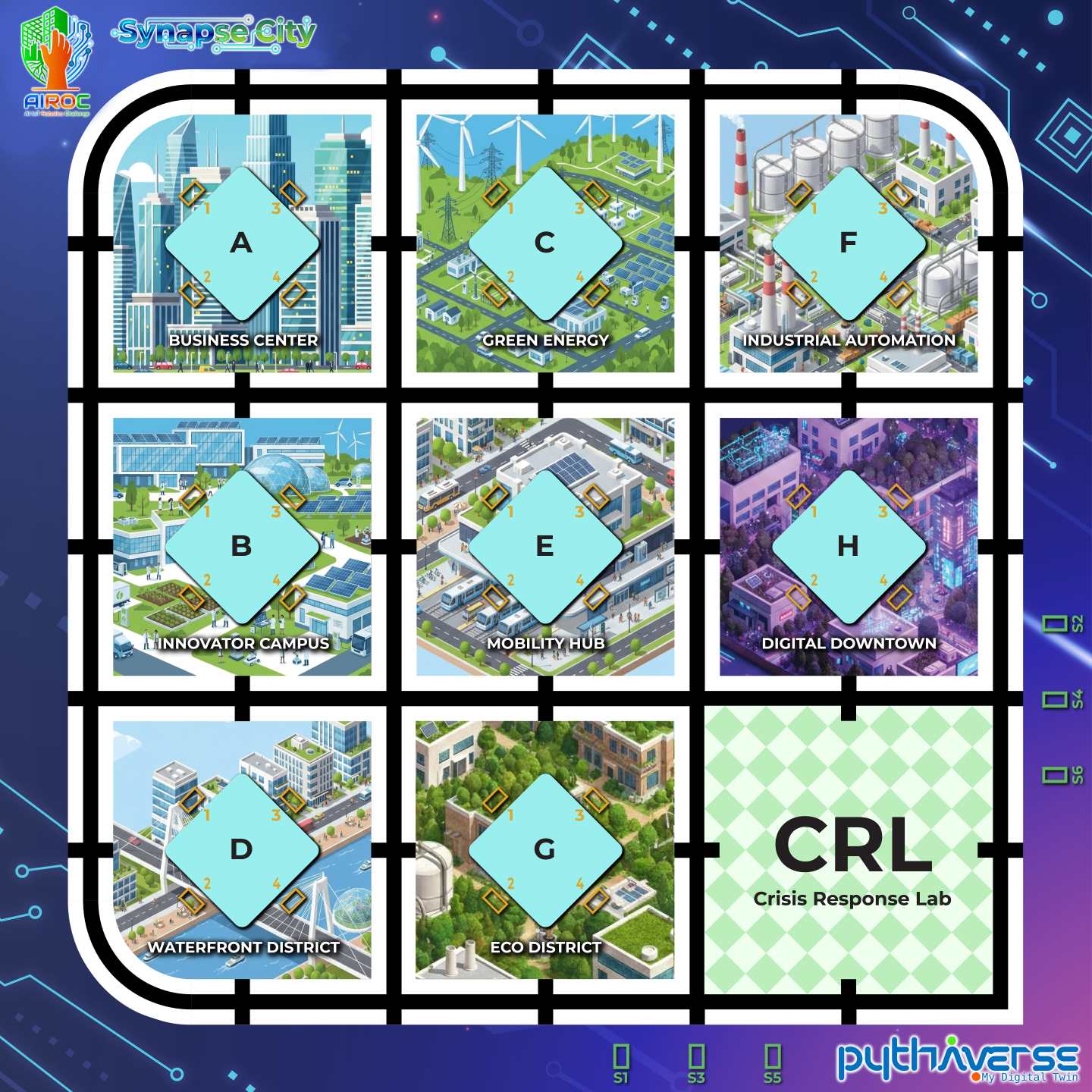
Synapse City — 4ft × 4ft Precision-Engineered Field Track
Core Mission Objectives
Three autonomous tasks to restore Synapse City — complete in any sequence within the 2-minute window
Containment
Move Pollution Source blocks scattered outside into the correct designated square(s) belonging to a City Block.
Pollution block must be touching the boundary of the target City Block
Neutralization
Transport Cleaning Devices (colored blocks) from Storage Sites to polluted locations. Color must match exactly!
Cleaning device matches the pollution source color exactly
Analysis
Transport unknown/mystery pollution samples to the Terminal for investigation. Master category includes Mystery Blocks.
Block must be positioned entirely within Terminal boundaries
Scoring & Evaluation
Maximize your score within the 2-minute window through strategic mission sequencing
| Mission | Action | Points |
|---|---|---|
| M2 Clean-up | Matching Red / Blue / Green device | 75 pts |
| M2 Bonus | Matching Yellow device 2× BONUS | 150 pts |
| M3 Analytic Lab | Unknown Color block inside Terminal | 150 pts |
| M3 Specialized | Purple Block inside Terminal | 120 pts |
Consistency
Smallest score difference between two rounds. Reliability beats lucky streaks.
Speed
If consistency is equal, the shortest time to complete missions wins.
Judicial Procedures & Protest Policy
Transparency and sportsmanship are core pillars of the AIROC competition
⚖️ Match Statuses
- FOUL
Called if a participant touches any items on the field track. The round ends immediately.
- FALSE START
Called if the robot moves before the countdown. The participant may restart, but the timer continues.
- STOP
Called by the participant when missions are complete, or by the Judge when the 2-minute duration expires.
📝 Result Confirmation & Protests
- 1
Freeze Phase
Immediately when a round ends, all objects must remain exactly as they are. Contestants must not touch the field.
- 2
Scoring Phase
Referees inspect each area, verify object positions, and calculate points.
- 3
Confirmation Phase
Team Leader reviews the score sheet. Once acknowledged, the result is final. No protests are accepted after this point.
Competition Categories
Four tiers scaling from guided exploration to multi-agent autonomous AI — all require fully autonomous solutions
Explorer
Ages 6–9Creator
Ages 9–12Innovator
Ages 11–15Master
Ages 15–17Competition Day Protocol
Four strict phases simulate real-world deployment pressure — no shortcuts allowed
Random 1
Pollution locations (A1, C3, etc.) are revealed to all teams
Coding
Use the Pythaverse Digital Twin to program logic, optimize routes, and calibrate sensors
Quarantine
Robots impounded. No code changes. Absolute engineering discipline required.
Random 2
Innovator/Master: Colors revealed now! Robots use Computer Vision to adapt in real-time
⏱️ After Random 2, teams have a 2-minute operational window — full autonomy, zero human intervention.
9-Milestone Learning Path
A structured 36-lesson STEM roadmap from sensor basics to real-time collaborative Physical AI
Physical Basics
Basic line movement (Primary) → Line movement + color sensor integration (HS)
Data Science
Teachable Machine Sound/Image recognition (Primary) → Advanced Color Data classification (HS)
AI Basic Practice
Teachable Machine Pose recognition (Primary) → Sensor-based color classification (HS)
Physical AI — Digital Twin
Simple simulated paths (Primary) → Advanced Pathfinding within a Digital Twin (HS)
Multi-Agents — IoT
N/A (Primary) → Optimized Real-time Collaborative Physical AI (HS)
Mission 1: Containment
Programmatic navigation (Primary) → AI-driven multi-agent containment (HS)
Mission 2: Neutralization
Simple transport (Primary) → AI-driven color matching multi-agent neutralizing (HS)
Mission 3: Analysis
Programmatic retrieval (Primary) → AI-driven data retrieval in multi-agent environments (HS)
Full Mission Mastery
Programmatic score maximization (Primary) → AI-driven strategy optimization (HS)
Regional Competition Presence Since 2006
Code • Connect • Compete — across 6 countries since 2006
Indonesia
2008, 2014, 2019, 2025
Malaysia
2009, 2015, 2023
Philippines
2010, 2016, 2025
Vietnam
2011, 2017, 2026
Thailand
2012, 2018, 2024
China
2013
Ready to Save Synapse City?
Join the next generation of Chief Engineers. Register your team and compete internationally.